Introduction
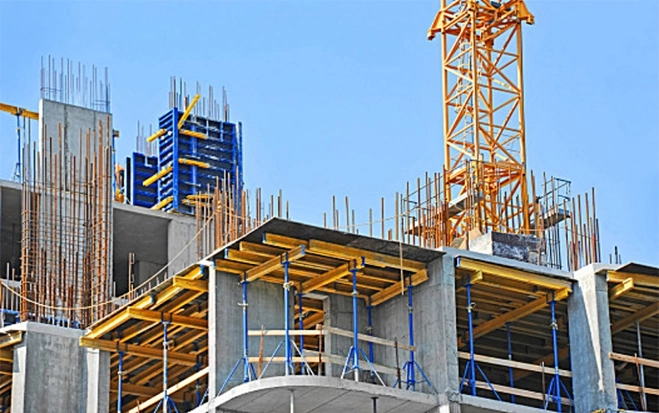
During concrete construction, freshly poured concrete is a fluid material that exerts substantial weight on the formwork system below. Until the concrete cures and gains sufficient structural strength to support itself, the formwork — and the concrete within it — must be held in place by temporary vertical support elements. These supports, known as steel props or shoring props, carry the load of the wet concrete, the formwork panels, and the construction loads imposed during pouring and finishing operations.
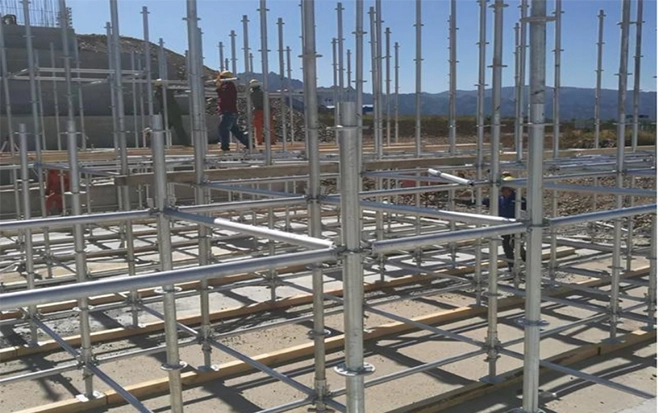
Steel props are distinct from scaffolding systems used for worker access. While scaffolding provides platforms for workers to stand on, props provide vertical load support for structural elements during construction. The two systems often work together on the same site — scaffolding for worker access, props for formwork support — but they serve fundamentally different structural functions and are selected against different criteria.
TSL Scaffolding, a scaffolding and shoring manufacturer with over 15 years of industry experience, produces steel props including adjustable steel shoring props, standard steel props, and adjustable shoring posts. The company operates four factories and exports to more than 50 countries, holding certifications including UL, FM, CE, SGS, ISO, and CBAM compliance. This article examines steel prop types, their structural function, application scenarios, and the factors construction buyers should evaluate when selecting a shoring prop supplier.
What Are Steel Props?
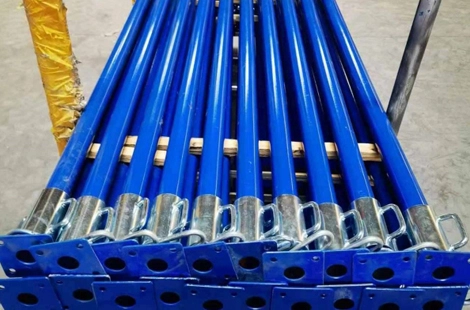
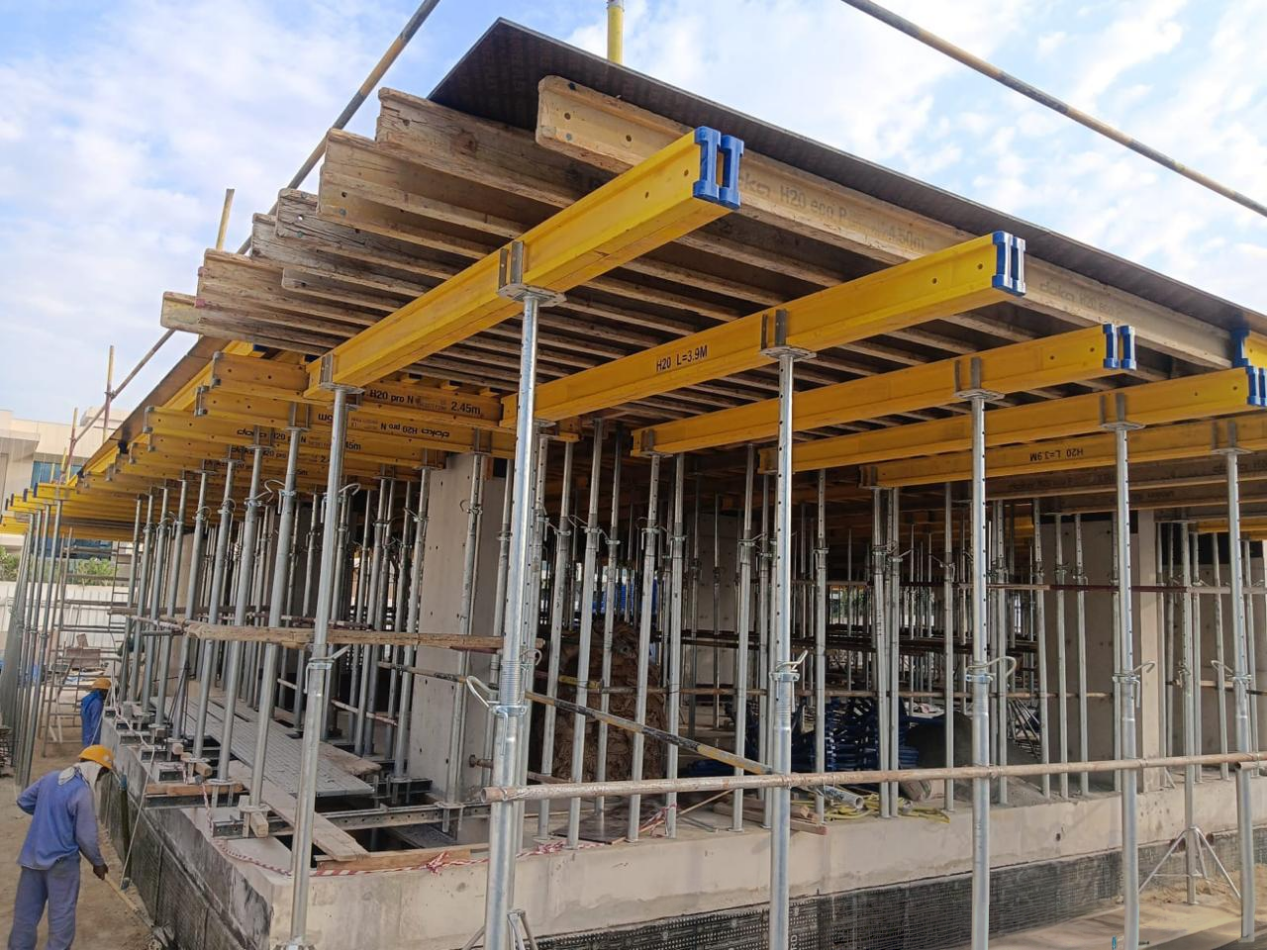
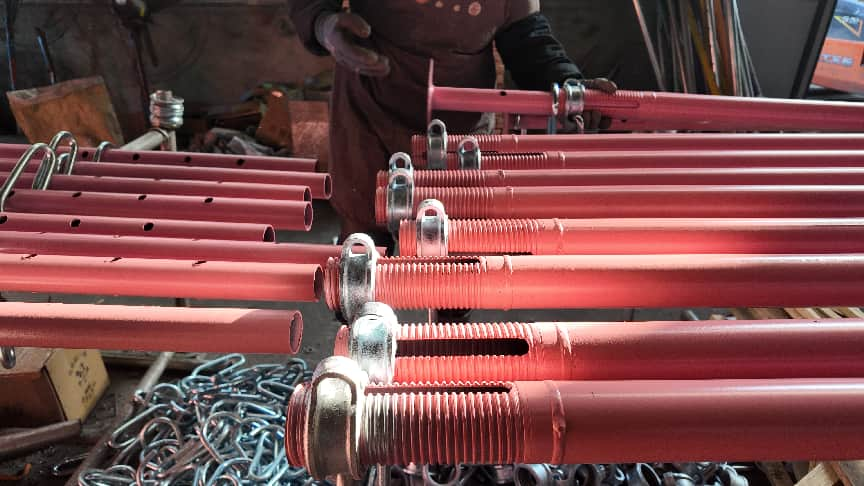
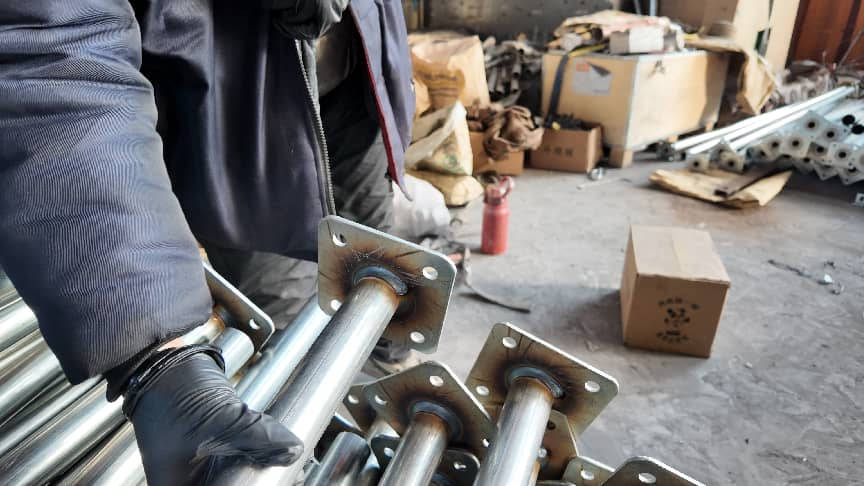
Steel props are telescopic tubular steel supports designed to bear vertical loads during construction. A prop consists of an inner tube that slides within an outer tube, allowing the overall height to be adjusted to the required support elevation. Once set to the correct height, the prop is secured using a locking mechanism — typically a pin-and-collar system for coarse adjustment and a threaded collar for fine adjustment.
The key components of a steel prop include:
Outer Tube: The larger-diameter tube that forms the base of the prop and houses the inner tube.
Inner Tube: The smaller-diameter tube that telescopes within the outer tube to adjust the prop's extended height.
Adjustment Collar (Threaded Nut): A threaded collar on the outer tube that rotates to provide fine height adjustment after the pin is set.
Pin Lock: A spring-loaded or captive pin that engages with holes in the inner tube to secure the coarse height setting.
Base Plate and Top Plate: Steel plates at the bottom and top of the prop that distribute the load to the ground surface and the supported element (formwork, beam, or slab) respectively.
Optional Features: Some props include a folding or detachable base plate for compact storage and transport.
TSL Scaffolding's steel prop product line includes adjustable steel shoring props, standard steel props, and adjustable shoring posts — covering different load capacities, height ranges, and project requirements.
Key Features and Advantages
Adjustable Height
The telescopic design allows a single prop to cover a range of support heights, reducing the need for multiple prop sizes on site. Coarse adjustment via the pin-and-hole system provides rapid height setting, while the threaded collar allows fine adjustment to achieve the exact support elevation required by the formwork layout.
Vertical Load Capacity
Steel props are engineered to carry the vertical loads imposed during concrete construction — the weight of wet concrete, formwork panels, reinforcement steel, and construction loads. The load capacity of a prop depends on its tube diameter, wall thickness, steel grade, and the extended length (a prop at maximum extension carries less load than the same prop at minimum extension). Confirming the prop's load rating at the required extension is essential for safe shoring.
Rapid Deployment
Props are installed by positioning the prop, setting the coarse height with the pin, and fine-tuning with the threaded collar. This process is faster than assembling frame or modular scaffolding for the same support application, making props practical for formwork support where many individual support points are needed.
Ground Adaptability
The base plate distributes the prop's load to the supporting surface. On uneven ground, the base plate can be shimmed or placed on a timber sole plate to provide a level bearing surface. The top plate can be adjusted to match the slope or profile of the supported formwork.
Reusability
Steel props are designed for repeated use across multiple construction projects. The tubular steel construction, protected by galvanized or painted surface treatment, withstands the handling, transport, and site conditions associated with construction operations. Props can be disassembled, transported, and redeployed without significant performance degradation.
Compact Storage and Transport
When collapsed, telescopic props occupy less space than fixed-height supports of the same maximum height. This compactness reduces transport volume and storage requirements — relevant for rental companies and contractors who move props between sites.
Main Applications
Slab Formwork Support
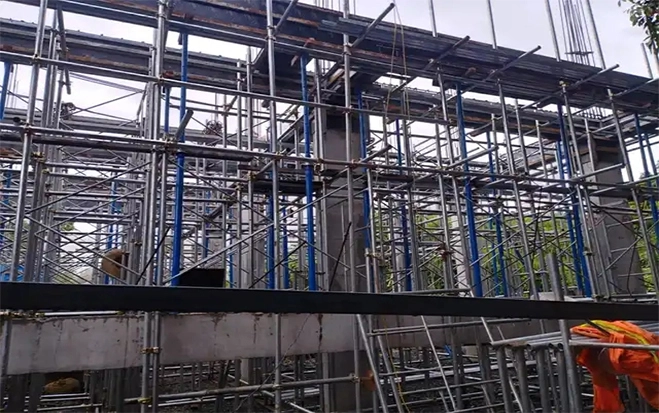
Horizontal concrete slabs — floor plates, roof slabs, and deck slabs — require dense arrays of props to support the formwork and wet concrete until the slab achieves self-supporting strength. Prop spacing is determined by the slab thickness, concrete volume, and formwork panel span capacity.
Beam Support
Concrete beams, lintels, and ring beams concentrate loads along a line, requiring props positioned at intervals along the beam length. The prop spacing for beam support is typically closer than for slab support because the beam load is concentrated.
Formwork for Columns and Walls
Vertical formwork for columns and walls may use props as horizontal or inclined braces to stabilize the formwork against concrete pressure during pouring. In this application, props resist lateral rather than vertical loads.
Staircase Construction
Staircase formwork involves angled and stepped surfaces that require props set at varying heights. The telescopic adjustment of steel props accommodates the height variations needed to support staircase formwork.
Repair and Renovation Shoring
In building renovation or structural repair, props provide temporary support for existing slabs, beams, or walls while structural elements are repaired, replaced, or modified. Props used in renovation must be positioned to carry the existing structure's loads safely during the work.
Industrial Construction
Industrial facilities — factories, warehouses, power plants — involve large-span concrete structures that require substantial shoring during construction. Props with appropriate load ratings support the heavier formwork and concrete volumes typical of industrial construction.
How to Choose Steel Props for Concrete Shoring: Key Factors
1. Required Load Capacity
Calculate the total load each prop must carry — including wet concrete weight, formwork weight, reinforcement steel, and construction loads (workers, equipment, material placement). Consult the prop's load capacity table at the required extended height, and verify that the prop's rating exceeds the calculated load with an appropriate safety margin. If the required load exceeds a single prop's capacity, reduce prop spacing or select a heavier-duty prop model.
2. Support Height Range
Determine the minimum and maximum support heights required for the project. Select a prop model whose telescopic range covers the required heights. Using a prop near its maximum extension reduces its load capacity — if the required height is near the prop's maximum, verify the load rating at that extension.
3. Prop Spacing and Layout
Design the prop layout based on the formwork panel span capacity and the calculated load per prop. Closer spacing reduces the load per prop but increases the number of props required. Balance the prop count against the load capacity to achieve an economical and safe shoring arrangement.
4. Surface Treatment
For outdoor or humid environments, select galvanized props for corrosion protection. Galvanizing extends prop service life and maintains the steel's structural properties in damp conditions. For indoor projects or short-term use, painted finishes may be adequate and more economical.
5. Base Plate and Top Plate Design
Verify that the base plate and top plate dimensions are appropriate for the supported formwork and the ground surface. Larger plates distribute load over a wider area, reducing ground pressure and preventing the prop from settling into soft surfaces.
6. Locking Mechanism Reliability
Evaluate the locking mechanism — the pin-and-collar system must hold the prop securely at the set height under load. Captive pins that cannot be lost are preferred on construction sites. The threaded collar should turn smoothly without excessive play.
7. Certification and Compliance
Confirm that the props meet relevant construction standards for the project location. TSL Scaffolding's UL, FM, CE, SGS, ISO, and CBAM certifications provide evidence of product testing against recognized standards. For projects in North America (UL, FM), Europe (CE, CBAM), or markets requiring third-party inspection (SGS), verify the applicable certifications.
8. Project Logistics
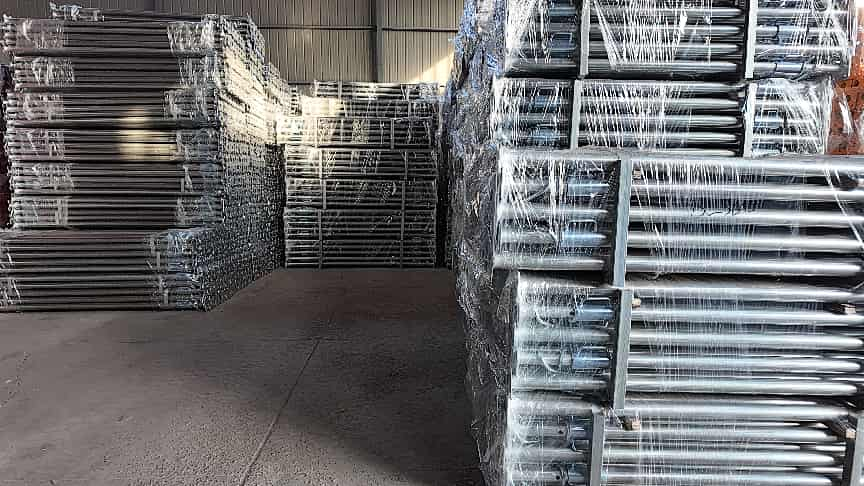
For large construction projects, evaluate the supplier's production capacity and delivery timeline. TSL Scaffolding's four-factory operation supports volume production. Confirm packaging, transport, and on-site delivery arrangements for large prop quantities.
Why Work with TSL Scaffolding
TSL Scaffolding brings the following capabilities to steel prop manufacturing:
15+ Years of Manufacturing Experience: The company's experience covers scaffolding and shoring design, production, and export operations across construction and infrastructure sectors.
Four Factories: Multiple production facilities provide manufacturing capacity for large-volume orders and support delivery timelines for major projects.
50+ Export Countries: An established export network indicates experience with international compliance requirements, documentation, and logistics.
Certification Portfolio: UL, FM, CE, SGS, ISO, and CBAM certifications provide evidence of product testing against recognized international standards.
Product Range: Beyond steel props, TSL Scaffolding manufactures ringlock scaffolding, frame scaffolding, and steel frame formwork — allowing buyers to source shoring, access, and formwork systems from a single supplier.
One-Stop Procurement: The company's product range supports comprehensive construction site equipment sourcing, including props, scaffolding, formwork, and accessories.
Project Experience: Application experience includes residential buildings, resort hotels, rail transit, and infrastructure projects — providing familiarity with diverse shoring requirements.
Buyers should request product specifications, load capacity tables, certification documents, and reference project information. For large orders, factory audits or third-party inspection may be appropriate to verify production quality and capacity.
Conclusion
Steel props provide the vertical load support required during concrete construction — carrying the weight of wet concrete, formwork, and construction loads until the structure achieves self-supporting strength. The telescopic design, adjustable height, and load capacity of steel props make them a practical shoring solution for slabs, beams, staircases, and renovation work.
TSL Scaffolding's steel prop product range — covering adjustable shoring props, standard steel props, and adjustable shoring posts — addresses the shoring needs of construction firms, formwork contractors, and scaffolding rental companies. Backed by 15+ years of manufacturing experience, four factories, 50+ export countries, and certifications including UL, FM, CE, SGS, ISO, and CBAM, the company supports both standard and project-specific shoring requirements.
For buyers evaluating steel prop suppliers, requesting product specifications, load ratings, certification documents, and delivery capabilities is the practical next step. Contact TSL Scaffolding to discuss project requirements and request a quote for your shoring needs.
 English
 Español
 português
 العربية