Introduction
Frame scaffolding remains one of the most widely used access systems in construction, valued for its straightforward assembly and predictable structural behavior. For procurement managers and contractors sourcing frame scaffolding internationally, the buying decision involves more than selecting a system type—it requires matching frame dimensions to project requirements, understanding load distribution across different bay widths, and planning orders around container capacity to control freight costs per unit.
This article focuses on the practical dimensions of frame scaffolding procurement: how standard frame sizes affect platform width and load capacity, what the component breakdown looks like per set, and how to use container loading data to optimize order quantities.
What Frame Scaffolding Offers
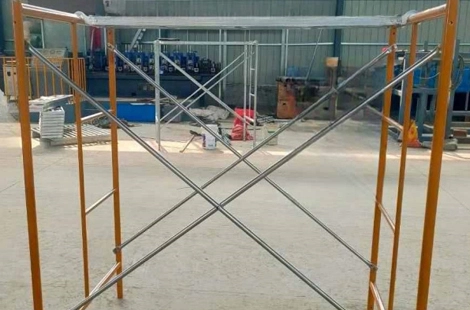
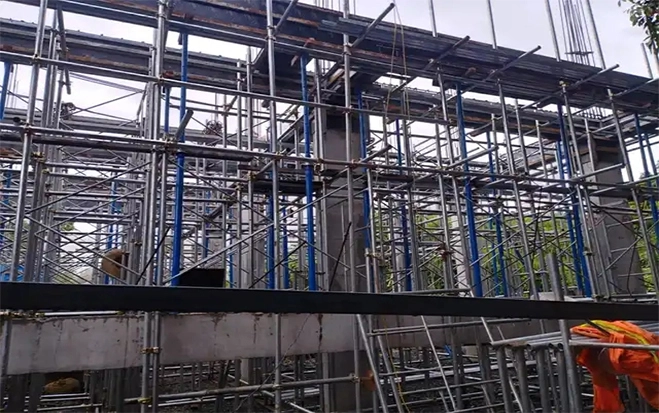
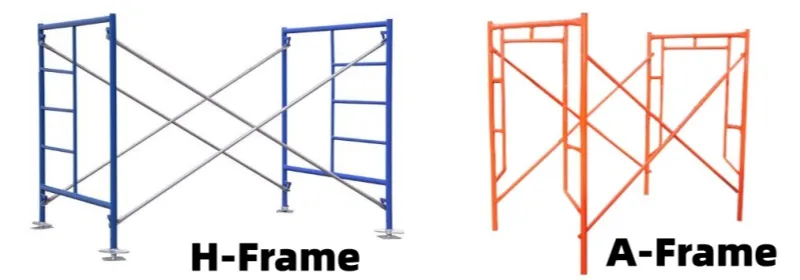
Frame scaffolding consists of prefabricated ladder-like frames connected by cross braces and joint pins. The system creates a stable working platform without the need for extensive loose fittings. Two common frame profiles—steel h frame scaffolding and A-frame scaffolding—share the same material specifications and component sets, differing primarily in structural geometry. Both use Q195 to Q235 steel with either painted or pre-galvanized surface treatment.
Each complete set includes two frames, two cross braces, and four joint pins. This modular structure allows workers to stack frames vertically and connect them horizontally to create platforms at multiple heights. The system is suitable for building construction, facade work, maintenance access, and temporary support applications where rapid assembly and straightforward configuration are priorities.
Standard Frame Scaffolding Sizes
Taishenglan Scaffolding offers frame scaffolding in different configurations to meet the space and working requirements of construction projects. The dimensions shown below represent typical frame sizes available for our scaffolding systems.
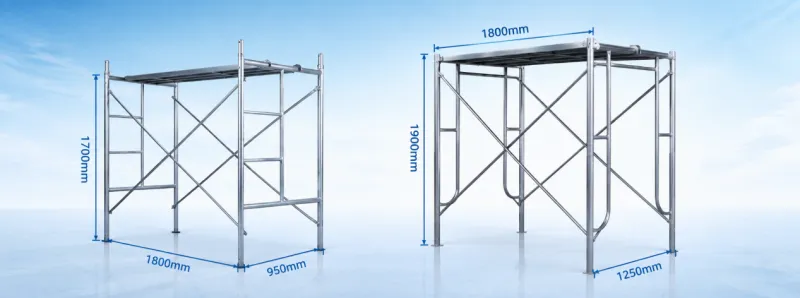
Size 1: 1800 × 950 × 1700 mm
The 1800 mm frame length, 950 mm width and 1700 mm height provide a compact configuration for projects where working space is limited.
The 950 mm width helps reduce the overall footprint of the scaffold, making this configuration suitable for façade maintenance, painting, inspection, installation and other construction tasks where a narrower working platform is preferred.
Size 2: 1800 × 1250 × 1900 mm
The 1800 mm frame length, 1250 mm width and 1900 mm height provide a larger working platform and greater vertical working space.
The wider 1250 mm platform offers more room for workers, tools and materials, making this configuration suitable for masonry, plastering, cladding, maintenance and general construction work.
Flexible Configurations for Different Projects
A frame scaffolding system can be configured with different frame dimensions, cross braces, platforms and accessories according to project requirements.
Choosing the appropriate frame size depends on factors such as available working space, required platform width, working height, access requirements and local safety regulations.
For specific projects, Taishenglan Scaffolding can provide suitable configurations and technical specifications based on your requirements.
Component Breakdown and Load Considerations
Each frame scaffolding set ships with two frames, two cross braces, and four joint pins. The frames carry the vertical and horizontal loads, while the cross braces provide lateral stability against wind and worker movement. Joint pins connect stacked frames and must be fully engaged to maintain structural continuity.
The Q195 to Q235 steel specification indicates the material grade range used in production. Q235 offers higher yield strength than Q195, which becomes relevant when scaffolding is used for material storage or in multi-tier configurations where lower frames carry the cumulative load of upper tiers. Buyers should confirm the actual material grade specified for their order, particularly for projects involving heavy material staging.
Surface treatment options—paint or pre-galvanizing—affect corrosion resistance and appearance. Painted surfaces are typically more economical and adequate for indoor or short-term outdoor use. Pre-galvanized surfaces offer better protection for outdoor projects or rental inventory subject to repeated exposure. Buyers should match the surface treatment to the expected storage conditions and project duration.
Container Loading and Order Planning
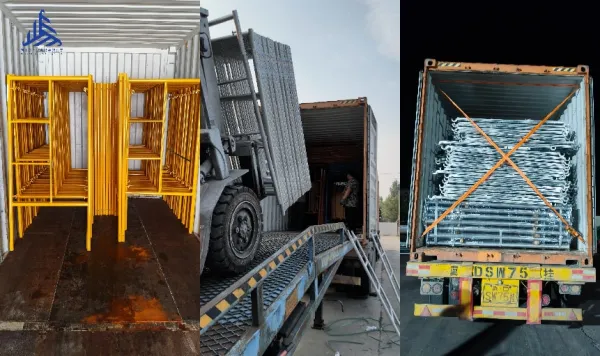
For international buyers, container capacity directly affects unit freight cost. Taishenglan Scaffolding provides the following loading data:
· 20-foot container: 200 to 230 sets per container
· 40-foot HQ container: 500 to 550 sets per container
The range accounts for variations in packaging density and whether accessories such as additional braces or base plates are included in the same shipment. A 40-foot HQ container offers more than double the capacity of a 20-foot container at a freight cost increase that is typically less than double, making the larger container more cost-efficient per set for bulk orders.
Buyers planning recurring purchases should calculate their average project consumption in sets, then align order quantities to container capacities. Ordering 250 sets in a 20-foot container leaves significant unused space and increases per-unit freight cost. Ordering 520 sets in a 40-foot HQ container maximizes space utilization and reduces landed cost per set.
For first-time buyers evaluating a new supplier, a 20-foot container trial order may be practical to verify product quality and packaging before committing to a full 40-foot HQ load. Buyers should also confirm whether the loading figures include wooden pallet bases or other packaging materials that affect net cargo weight and container space usage.
How to Choose the Right Frame Size and Order Quantity
Buyers evaluating frame scaffolding for upcoming projects should address the following questions:
1. What bay width does the project require?
Match the frame width to the task. Narrow bays (0.95M) work for inspection and light finishing work. Wider bays (1.25M) support material handling and multi-worker platforms. If the project involves varying tasks along a facade, consider ordering both widths and switching frame types at different elevations.
2. What is the target working height?
The 1.82-meter lift height determines how many tiers are needed to reach the work area. The 1.8-meter frame height option reduces the tier count by approximately six percent compared to the 1.7-meter option, but buyers should verify that the taller frame meets local bracing and tie requirements.
3. What loads will the platform carry?
Light-duty applications—painting, inspection, cleaning—place minimal demand on frame capacity. Heavy-duty applications—masonry, cladding panels, material storage—require confirmation that the specified material grade and wall thickness support the expected live and dead loads.
4. How does the order fit container capacity?
Calculate total set requirements for the project or annual consumption, then round to the nearest container capacity. Mixing frame sizes within one container is possible, but buyers should confirm with the supplier how mixed loads affect the total set count per container.
5. What surface treatment matches the project environment?
Dry climates and indoor projects can use painted surfaces. Outdoor projects in humid or coastal regions benefit from pre-galvanized treatment. Rental companies maintaining mixed inventories should consider whether standardizing on one surface treatment simplifies maintenance and resale value tracking.
6. What accessories are needed?
Base plates, caster wheels, guardrails, and toe boards are typically ordered separately. Buyers should include these in the initial procurement plan rather than placing a follow-up order that incurs additional freight costs.
Why Work with This Supplier
Taishenglan Scaffolding produces frame scaffolding in the three standard sizes described above, with material grades, surface treatments, and packaging configurations that can be adjusted to match project requirements. Buyers working with this supplier can expect:
· Product series coverage: H-frame and A-frame profiles are both available, along with compatible cross braces, joint pins, and accessories.
· Size flexibility: Buyers can order single sizes or mixed configurations within the same shipment.
· Container load optimization: Loading data is provided for 20-foot and 40-foot HQ containers, supporting freight cost planning.
· Customization support: Non-standard frame heights, specific material grades within the Q195-Q235 range, and custom packaging can be discussed for large orders.
· Documentation support: Specification sheets and component lists are available for engineering review and customs clearance.
· Stable supply: Multiple production lines support recurring orders for contractors and rental companies with ongoing demand.
Conclusion
Frame scaffolding procurement involves more than selecting a system type. Buyers need to match frame dimensions to project tasks, confirm that material grades support expected loads, and align order quantities with container capacities to control freight costs. The three standard sizes—1.7M × 0.95M, 1.7M × 1.25M, and 1.8M × 0.95M—cover most facade access and construction support applications, with the choice of bay width and frame height depending on workspace needs and regulatory requirements.
If you are planning a frame scaffolding purchase and need help selecting sizes, calculating container loads, or matching specifications to your project, contact Taishenglan Scaffolding to discuss your requirements.
 English
 Español
 português
 العربية